Papers by Francisco Calafate-Faria
Call for abstracts , 2022
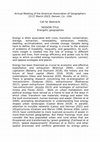
Energy is often associated with crisis, transition, conservation, storage, extraction, renewabili... more Energy is often associated with crisis, transition, conservation, storage, extraction, renewability, exhaustion, mobility, dwelling, acclimatization, and climate change. Despite being hard to define, the concept of energy is crucial to the analysis of problems of liveability, inequality, and geopolitics. As such, more insight is needed into the role of energy in different spaces and lives, from energy efficiency and power cuts to the ways in which so-called energy transitions transform, connect, and oppose ecologies and places.
Energy has been theorized as crucial to economic and affective exploitation and exhaustion (Brennan 2000), crises of capitalism (Bellamy and Diamanti 2018), the history and the future of fossil capital (Malm 2016, 2018), and new materialisms (Hess and Sovacool 2020, Murphy et al 2021). There is growing research concerning the re-energisation of 'extractivisms' (Gudynas 2021), 'extractivismo' (Riofrancos 2017), 'green extractivism' (Voskoboynik and Andreucci 2021), 'neo-extractivism' (Acosta 2013) and 'ecologies of extraction' (Ureta and Flores 2022). Work on urban metabolism and political ecology have served as a frame to look at the ways in which cities ‘transform raw materials, energy and water into the built environment, human biomass and waste’ (Decker et al 2000), prompting developments in understanding how energy shapes urban landscapes (Castan Broto 2019). In parallel, attention to invisible networks (Latour and Herman 2021) and infrastructures (Graham and Marvin 1996, Simone 2004, Larkin 2013) have contributed to more nuanced accounts of power in more-than-human geographies. But these framings must also consider the less populated urban and rural areas that are threatened and transformed by 'green grabbing' (Fairhead et al 2012), 'global displacements' (Kramarz et al 2021), and other spatial processes and conflicts generated by energy policy (Bridge and Gailing 2020) that have been highlighted by political ecology scholars and activists.
This call for papers seeks to bring together different perspectives on how energy is produced, transported, stored, and consumed in specific places, how it links the fates of distant geographies, and how it is crucial to the functioning of cities, homes, mining projects, national economies, and global supply chains. We are also interested in how the inter-conversion between energy and matter produces ecologies, inequalities, resistances, and other forms of agency in the critical spaces of these conversions.
We invite empirical, theoretical, speculative, interdisciplinary, and/or creative papers that shed light on how energy conversions shape people, materials, ecology, and places. These could focus on, but not be limited to:
• energy crisis and transitions
• home retrofitting
• transformations and reimaginations of urban mobility
• sacrificial zones of energy transition
• green mining
• conflicts around the mining of lithium, cobalt, rare earths, and other ‘critical materials’
• energy policy mobilities
• vertical energy geographies
• subterranean and underground geographies
• energy infrastructures
• landscapes of energy extraction and storage
• exhaustion and ends of the world
• green grabbing
• toxic colonialism
• geo-symbioses
• conflicts around fracking
• mineral rights
• temporalities of extraction
• energy materialities.
We welcome presentations in non-traditional and participatory formats. Abstract selection will be based on relevance to the CfP, boldness, and quality of the proposal. Short papers or presentations of max. 3,000 words must be circulated two weeks in advance of the conference.
Please send abstracts of no more than 250 words to Francisco Calafate-Faria ([email protected]), Sam Johnson-Schlee ([email protected]) and Phil Pinch ([email protected]) by the 1st of November. We will confirm acceptance by the 5th of November, and we expect you to register and submit your abstract on the AAG website by the 8th of November.
Marginal attachment and countercycling in the age of recycling

Multi-sensory ethnography and ascending the Peckham skyline: non-ocular vistas, verticality and urban transformation
This paper draws on research into ongoing transformations of spaces above street level in Peckham... more This paper draws on research into ongoing transformations of spaces above street level in Peckham, southeast London, in order to understand how vertical urban transformation remakes power and inequality in the city through a focus on two spaces at height that have been remade as spaces for leisure. As we argue, multi-sensory ethnography offers the possibility of enriching critical analysis of these repurposed spaces at height in ways that make visible how social and spatial inequalities are (re)produced through three-dimensional geographies. With a methodological focus on embodiment and experience, we offer unique insights into how power functions in and is distributed through these spaces at height in Peckham, reflecting on the experience of ascending the rooftops, on the possibilities for sensory detachment, and the potential for conviviality. These reflections foreground the consideration of the bordering practices through which spaces at height are made, and in bringing in non-o...
Social & Cultural Geography, 2019
In this paper, we offer a conceptual and methodological intervention that demonstrates how multi-... more In this paper, we offer a conceptual and methodological intervention that demonstrates how multi-sensory ethnography might enrich critical analysis of vertical urban transformation. Through the lens of two sites in Peckham, southeast London-a multistory car park and an ex-industrial warehouse complex-recently remade as leisure and retail spaces, we examine how processes and practices by which these spaces at height are designed and curated reproduce social and spatial inequalities. As we argue, in retraining the vantage point of research on verticality through attention to other senses-which we label here as non-ocular vistas-new perspectives and texture are brought to understandings of place-making, that address how power functions through the erection of physical, symbolic and sensory exclusions, and how sensorial clashes makes visible contestations over space in a changing urban environment. In this way, our contribution: (1) privileges a multi-sensory perspective in understanding how power is reproduced in and through the vertical transformation of the city; (2) intervenes in research on verticality to centre the concept of non-ocular vistas; and (3) offers a methodological innovation that make visible the subtle affects that manifest the politics of exclusion within spaces at height.
International Journal of Urban and Regional Research, 2014
This thesis is a sociological investigation on the recycling of urban waste. It is based on field... more This thesis is a sociological investigation on the recycling of urban waste. It is based on fieldwork carried out in the Brazilian city of Curitiba. The author used a combination of interviews, analyses of quantitative data, and participant observation to understand the work and modes of organisation of informal collectors of recyclables in this city. Curitiba is known in Brazil as the “first-world capital” and, in the world of urban planning, as a “model city” or an “ecological capital city”. These encomiums result in part from Curitiba’s ground-breaking recycling campaigns and systems of waste collection, sorting, and commercialisation. However, the city’s model image hides an army of urban poor and circuits of informal transactions that actually do most of the recycling work. These informal infrastructures are mostly responsible for the city’s official recycling rates, which are comparable to those of the most recycle-minded European cities. The main objective of this research pr...
Trash Talk: Unpicking the deadlock around urban waste and regeneration
The Sociological Review Online
Making space for waste
Spatial Justice in the City
Spatial Justice in the City, edited by Sophie Watson, 2019
How does the devaluation of spaces for disposal affect environmental sustainability at large? By ... more How does the devaluation of spaces for disposal affect environmental sustainability at large? By mobilising spatial justice as both a moral and a utilitarian concept, this chapter brings attention to the political conditions necessary for the reproduction of polluting economies, and thus contribute to link local environmental struggles with mitigation of environmental damage.
Multi-sensory ethnography and vertical urban transformation: ascending the Peckham Skyline
Social and Cultural Geography, 2019
In this paper, we offer a conceptual and methodological intervention that demonstrates how multi-... more In this paper, we offer a conceptual and methodological intervention that demonstrates how multi-sensory ethnography might enrich critical analysis of vertical urban transformation. Through the lens of two sites in Peckham, southeast London – a multi-storey car park and an ex-industrial warehouse complex – recently remade as leisure and retail spaces, we examine how processes and practices by which these spaces at height are designed and curated reproduce social and spatial inequalities. As we argue, in retraining the vantage point of research on verticality through attention to other senses – which we label here as non-ocular vistas – new perspectives and texture are brought to understandings of place-making, that address how power functions through the erection of physical, symbolic and sensory exclusions, and how sensorial clashes makes visible contestations over space in a changing urban environment. In this way, our contribution: (1) privileges a multi-sensory perspective in understanding how power is reproduced in and through the vertical transformation of the city; (2) intervenes in research on verticality to centre the concept of non-ocular vistas; and (3) offers a methodological innovation that make visible the subtle affects that manifest the politics of exclusion within spaces at height
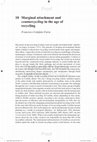
Discourses on the recycling of urban waste are usually articulated under 'unpoliti-cal' eco-logic... more Discourses on the recycling of urban waste are usually articulated under 'unpoliti-cal' eco-logics (Crenson, 1971). The pressure of looming environmental threats makes it harder to discern how recycling circuits benefit some agents and margin-alize others. I argue that circuits of material recycling are assemblages of humans, technologies, streams of materials, and social relations that demand the discussion of notions of social justice and attention to uneven urban geographies. Contrary to what is communicated by the visual symbol of recycling, the circuits set in motion beyond each bin, commercial truck, package material, or council leaflet that displays it, are not simply flat, fluid, unilinear, and circular movements of waste from selective bins back to commercial shelves. If one follows the materials and the bodies that transport and transform them, one will encounter the transactions, attachments, interactions, hinges, mechanisms, and 'membranes' through which inequality is engendered and reproduced. This chapter centres on the recycling circuits set in motion by informal waste pickers in Curitiba, Brazil. The city's strong recycling culture combines aspects of the urban South with models characteristic of wealthier cities in the global North. Catadores (the Brazilian informal waste pickers) are people who rummage through the city's waste in search of materials to sell. They form a group of highly marginalized people, from migrants recently arrived from rural areas to long-term inner-city slum dwellers, mostly with no formal relationship with the bureaucratic or welfare state. These informal recyclers are attracted and marginalized by the luring promises of urban recycling. In Curitiba, where, depending on who counts, 4,000 to 50,000 catadores operate, recycling is also closely connected to dominant discourses of efficiency and environmental sustainability. In 1989, this city developed one of the first campaigns promoting household recycling in the world. In the years that followed, partly because of its recycling model, Curitiba became known in Brazil as the 'first world capital city' and in international circuits of urban planning as a 'model of ecological efficiency' (cf. Rabinovitch
Has the tide turned? "Regeneration" then and now: 21 Years of Urban Change in Deptford
Article on Goldsmiths Academics promoting an event organised with the Centre for Urban and Commun... more Article on Goldsmiths Academics promoting an event organised with the Centre for Urban and Community Research
Thesis Chapters by Francisco Calafate-Faria
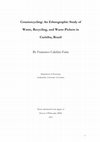
Countercycling: An Ethnographic Study of Waste, Recycling, and Waste-Pickers in Curitiba, Brazil
This thesis is a sociological investigation on the recycling of urban waste. It is based on field... more This thesis is a sociological investigation on the recycling of urban waste. It is based on fieldwork carried out in the Brazilian city of Curitiba. The author used a combination of interviews, analyses of quantitative data, and participant observation to understand the work and modes of organisation of informal collectors of recyclables in this city. Curitiba is known in Brazil as the “first-world capital” and, in the world of urban planning, as a “model city” or an “ecological capital city”. These encomiums result in part from Curitiba’s ground-breaking recycling campaigns and systems of waste collection, sorting, and commercialisation. However, the city’s model image hides an army of urban poor and circuits of informal transactions that actually do most of the recycling work. These informal infrastructures are mostly responsible for the city’s official recycling rates, which are comparable to those of the most recycle-minded European cities. The main objective of this research project was to highlight what has been wasted in the building of these idealised images, both of the city and of municipal recycling. The work, organisation, and political struggles of waste-pickers in Curitiba provided the opportunity to carry out this project. Through their work and forms of organisation, waste-pickers (catadores) struggle for a space and for change in the urban economy. The author’s thesis is that catadores’ position in between systems of value, presents a chance to challenge dominant discourses on recycling, which waste people and resources. I introduce the notion of 'countercycling' in order to make sense of the hidden politics of urban recycling.
research reports by Francisco Calafate-Faria
Book Reviews by Francisco Calafate-Faria
Deadline for submission of 250 words abstract: 20 th of October. Deadline for registration on AAG... more Deadline for submission of 250 words abstract: 20 th of October. Deadline for registration on AAG website 26 th of October.
Talks by Francisco Calafate-Faria

2018
Several authors writing from the Global South have associated the traits of the post wage economy... more Several authors writing from the Global South have associated the traits of the post wage economy with pre-industrial labour relations (e.g. Medeiros Macedo 2006; Antunes 2008; Oliveira 2004; Bossi 2009). Some of these analyses point to the fact that there is a regression in the conditions of Western workers. In others it is the plight of ‘informal’ labourers in the Global South that appears as model to the class struggles of the future. I propose that we think with different temporal frames when studying the reconfigurations of work and the articulation between continuity and change. Drawing on practical examples from my research with urban waste and repair infrastructures in Curitiba and London, this paper develops a rhythmanalitical approach (Lefebvre) as a way to connect experiences of urban marginality in both hemispheres. These cases are connected neither by geographical contrast nor by historical linearity. Rather, urban waste and repair offer a common vantage points to crucial temporal frames. Through their specific rhythms that produce and reproduce the city these forms of material work shed light onto post-productive activities that are nevertheless vital. In order to overcome the limiting dichotomy between pre-modern circular time and linear progress, this paper highlights the tension between the rhythms of infrastructural care and the appeals for the “big clean up” that threaten to expel those whose pulsating energy and tempo keep the cities working.
The Smartness of Cities (La Inteligencia de las ciudades)
Key-note at the launch of the project 'Smart Social Districts' organized by the municipality of L... more Key-note at the launch of the project 'Smart Social Districts' organized by the municipality of L'Hopitalet de Llobregat (Barcelona mr)
Talk at art project Tapescape, which used donated old video tapes.



Uploads
Papers by Francisco Calafate-Faria
Energy has been theorized as crucial to economic and affective exploitation and exhaustion (Brennan 2000), crises of capitalism (Bellamy and Diamanti 2018), the history and the future of fossil capital (Malm 2016, 2018), and new materialisms (Hess and Sovacool 2020, Murphy et al 2021). There is growing research concerning the re-energisation of 'extractivisms' (Gudynas 2021), 'extractivismo' (Riofrancos 2017), 'green extractivism' (Voskoboynik and Andreucci 2021), 'neo-extractivism' (Acosta 2013) and 'ecologies of extraction' (Ureta and Flores 2022). Work on urban metabolism and political ecology have served as a frame to look at the ways in which cities ‘transform raw materials, energy and water into the built environment, human biomass and waste’ (Decker et al 2000), prompting developments in understanding how energy shapes urban landscapes (Castan Broto 2019). In parallel, attention to invisible networks (Latour and Herman 2021) and infrastructures (Graham and Marvin 1996, Simone 2004, Larkin 2013) have contributed to more nuanced accounts of power in more-than-human geographies. But these framings must also consider the less populated urban and rural areas that are threatened and transformed by 'green grabbing' (Fairhead et al 2012), 'global displacements' (Kramarz et al 2021), and other spatial processes and conflicts generated by energy policy (Bridge and Gailing 2020) that have been highlighted by political ecology scholars and activists.
This call for papers seeks to bring together different perspectives on how energy is produced, transported, stored, and consumed in specific places, how it links the fates of distant geographies, and how it is crucial to the functioning of cities, homes, mining projects, national economies, and global supply chains. We are also interested in how the inter-conversion between energy and matter produces ecologies, inequalities, resistances, and other forms of agency in the critical spaces of these conversions.
We invite empirical, theoretical, speculative, interdisciplinary, and/or creative papers that shed light on how energy conversions shape people, materials, ecology, and places. These could focus on, but not be limited to:
• energy crisis and transitions
• home retrofitting
• transformations and reimaginations of urban mobility
• sacrificial zones of energy transition
• green mining
• conflicts around the mining of lithium, cobalt, rare earths, and other ‘critical materials’
• energy policy mobilities
• vertical energy geographies
• subterranean and underground geographies
• energy infrastructures
• landscapes of energy extraction and storage
• exhaustion and ends of the world
• green grabbing
• toxic colonialism
• geo-symbioses
• conflicts around fracking
• mineral rights
• temporalities of extraction
• energy materialities.
We welcome presentations in non-traditional and participatory formats. Abstract selection will be based on relevance to the CfP, boldness, and quality of the proposal. Short papers or presentations of max. 3,000 words must be circulated two weeks in advance of the conference.
Please send abstracts of no more than 250 words to Francisco Calafate-Faria ([email protected]), Sam Johnson-Schlee ([email protected]) and Phil Pinch ([email protected]) by the 1st of November. We will confirm acceptance by the 5th of November, and we expect you to register and submit your abstract on the AAG website by the 8th of November.
Thesis Chapters by Francisco Calafate-Faria
research reports by Francisco Calafate-Faria
Book Reviews by Francisco Calafate-Faria
Talks by Francisco Calafate-Faria